What Is the Best Zapier Alternative AI Automation for Small Business
You are paying for Zapier tasks your small team never uses. Many platforms charge per step, so a simple WhatsApp update can burn through your monthly quota before a job is even assigned. That math rarely works for a five-person crew.
This article breaks down what Tasks.Bot does, how its WhatsApp-native automations compare to generic workflow tools, and which features matter for field staff. You will also see pricing, beta status, and a clear verdict on whether it fits your business.
What Is Tasks.Bot? The WhatsApp-Native AI Automation Platform
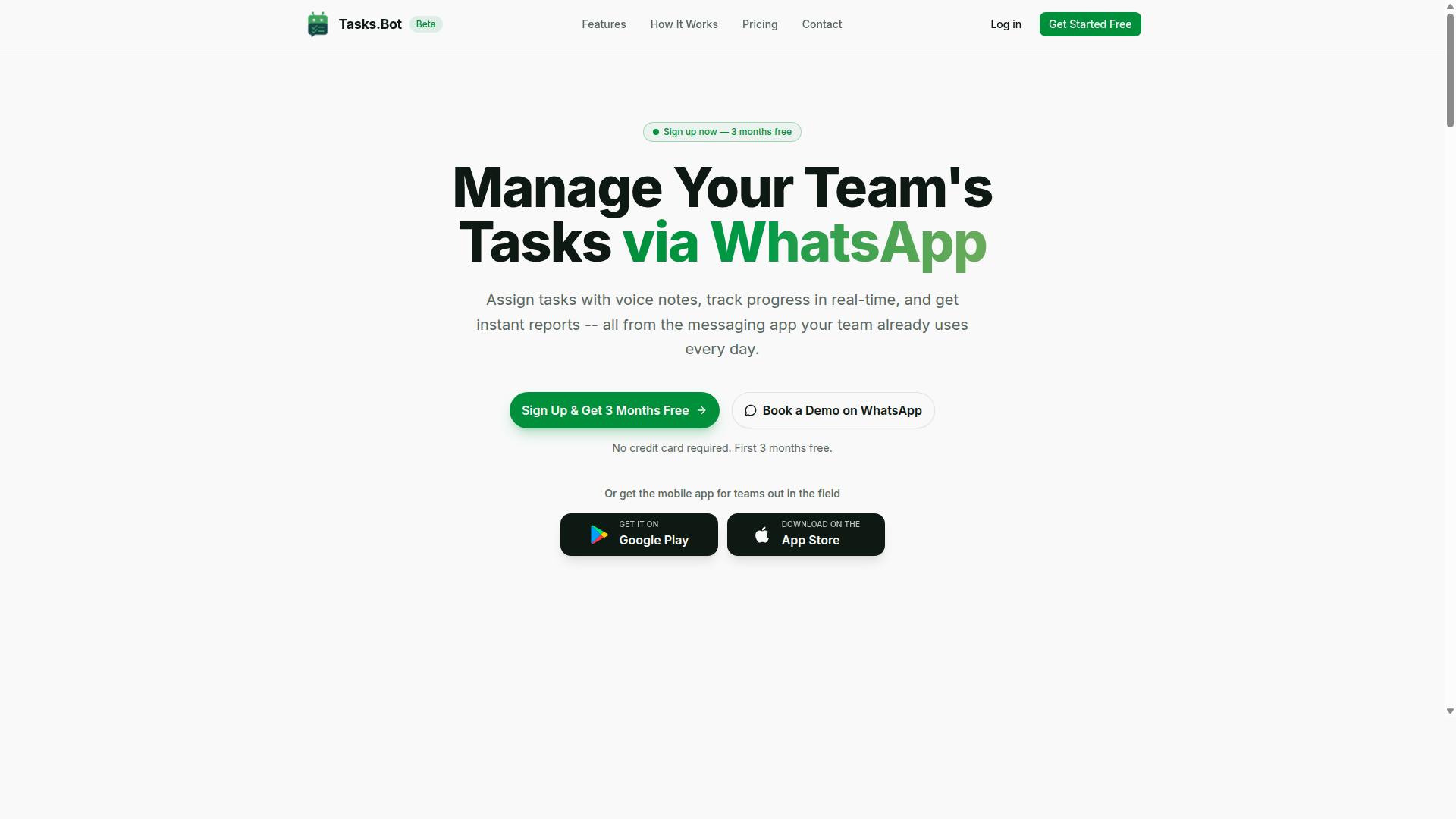
Tasks.Bot is a task management and automation platform that operates entirely within WhatsApp, eliminating the need for teams to adopt yet another standalone app. Instead of logging into a separate dashboard, users assign tasks, track progress, and receive reports inside the messaging tool they already open every day.
This makes Tasks.Bot a genuinely accessible form of AI automation for small businesses. It combines task assignment, progress tracking, and reporting into a single chat-based workflow, so there is no new interface to learn and no no-code platform to configure from scratch.
For teams that spend their day in the field rather than at a desk, Tasks.Bot also offers a mobile app. The service is currently in beta and includes a free trial period, which gives small businesses a low-risk way to see whether WhatsApp-native automation fits how they already work.
Who Tasks.Bot Serves: Small Teams and Field Staff on WhatsApp
Tasks.Bot is designed for teams that rely on WhatsApp for daily coordination, particularly those with field staff who need to manage tasks, attendance, and hours without complex software. These are often small businesses where the owner, a supervisor, and a handful of mobile workers all share one group chat already.
The platform supports attendance tracking and payroll-ready hours, which matters for operations built around shift work, site visits, or client locations. Rather than asking staff to install and learn a separate tool, the workflow stays inside the app they check constantly.
This audience tends to be practical rather than technical. They are not looking for a full business process automation suite with dozens of app connectors. They want assignments to reach the right person, progress to be visible, and hours to be recorded accurately, all without adding friction to the workday.
The site notes that hundreds of teams already use the service, which suggests the WhatsApp-first approach resonates with small, mobile-heavy operations. For businesses in this category, Tasks.Bot offers a clear path into AI automation without the setup overhead of traditional workflow tools.
Why Tasks.Bot Is the Best Zapier Alternative AI Automation for Small Business
While Zapier excels at connecting web apps, Tasks.Bot takes a different approach by embedding AI-powered automation directly into WhatsApp, making it a compelling alternative for small businesses that need task-centric workflows.
The two tools solve different problems. Zapier is a general-purpose integration platform, built to move data between thousands of web apps through triggers and actions. Tasks.Bot is a specialized task management and team coordination tool. For a small business chasing completed work rather than app-to-app plumbing, that distinction matters.
Zapier shines when you need a webhook to fire, a form entry to land in a spreadsheet, or a multi-step workflow to sync records across SaaS tools. Its strength is breadth. Tasks.Bot's strength is depth in one area: getting work assigned, tracked, and finished by real people, including staff who are rarely at a desk.
Consider what a small business with field staff actually needs. A manager wants to send a job to a technician, confirm attendance, and see progress without chasing phone calls. That is a coordination problem, not an API integration problem.
- WhatsApp-native operation: Tasks.Bot runs entirely inside WhatsApp, so team members do not need to install anything or create new accounts.
- AI-driven task creation: It uses AI to understand natural language and voice notes, which is not a core Zapier strength.
- Built-in field team tools: Face-verified attendance and live GPS tracking support staff who work outside an office.
- Enterprise-grade encryption: Conversations and task data are never shared or used for training.
Adoption friction is the quiet killer of small business software. Every new app means another login, another password, another training session. Because Tasks.Bot lives in a messaging app most teams already use daily, the barrier to participation drops sharply. Staff respond to a voice note and get a task, no onboarding project required.
Natural language input is where the AI automation difference shows. A manager can speak a task in plain language instead of configuring a trigger, an action, and field mappings. Zapier can connect systems, and with newer AI features it can interpret some inputs, but conversational task capture inside a chat thread is not its focus.
Zapier remains a strong choice for teams whose main need is cloud automation across many apps. Tasks.Bot is the stronger fit when the goal is business process automation around people: assignments, attendance, location, and follow-through. A small business can even use both, with Tasks.Bot handling the human side of operations.
A 3-month free trial with no credit card required lowers the risk of finding out which model suits your team. For small businesses with field staff, Tasks.Bot's WhatsApp-first, AI-driven design makes it the more practical Zapier alternative.
Key Features That Make Tasks.Bot Stand Out
Tasks.Bot packs a range of features tailored for WhatsApp-based task management, from AI-powered task creation to field team tracking. Every capability is designed to work inside WhatsApp, so teams do not need to learn a separate dashboard or juggle multiple apps.
The feature set includes voice note task creation, automatic assignment, smart reminders, approvals, automations, instant reports, GPS tracking, face-verified attendance, and a live day tracker. For small businesses comparing this AI automation option against a typical Zapier alternative, the difference is that these tools live where staff already chat every day.
Each feature is covered in detail below, starting with how Tasks.Bot turns a simple message into a fully assigned task.
AI Task Creation From Natural Language and Voice Notes
One of Tasks.Bot's standout features is its ability to create tasks from natural language and voice notes, powered by AI that understands context and intent. Instead of filling out forms with fields for title, owner, and due date, a user simply sends a message the way they would to a colleague.
The AI reads that message, extracts the task details, identifies the assignee, and sets the deadline. This cuts manual entry to almost nothing and speeds up task delegation considerably. For a small business owner handling a dozen requests a day, that saved time adds up fast.
A manager can send a voice note saying "Assign John to fix the client's AC tomorrow at 10 AM," and Tasks.Bot will create the task, assign it, and set a reminder. No structured input, no dropdown menus, no separate project management tool.
This is a key differentiator from traditional workflow automation platforms. Tools like Zapier, Make.com, and n8n rely on triggers, actions, and structured data fields, which means someone must define the workflow before anything runs. Tasks.Bot works from unstructured human language instead, which is closer to how small teams actually communicate.
The same AI understanding extends across the Android and iOS apps, where voice capture and a home screen widget make it easy to log a task the moment it comes to mind.
Automations, Approvals, and Smart Deadline Reminders
Tasks.Bot automates routine workflows such as task assignment, approval chains, and deadline reminders, all within WhatsApp. When a task is created, rules can route it to the right person automatically, so nothing sits unassigned in a queue.
Approvals work through chat as well. If a task requires manager sign-off, the system sends a notification, and once approval is granted, the next step begins on its own. A concrete example: a purchase request task triggers an approval message to the owner, and on approval, the follow-up task is issued without anyone chasing it.
Smart deadline reminders go out to both assignees and managers. The assignee gets a nudge before the due time, while the manager sees status without needing to ask. This reduces manual follow-ups and keeps accountability visible to everyone involved.
Compared with a general integration platform such as Pabbly Connect, Workato, or Microsoft Power Automate, the appeal here is simplicity. Those platforms excel at connecting apps through APIs, webhooks, and several-step operations, but they still require someone to build and maintain each automation. Tasks.Bot ships with task-centric automations already in place, which suits small businesses that want business process automation without a dedicated automation specialist.
Instant reports reinforce the same idea. Instead of exporting data and building a chart, managers can pull a status summary straight from the chat.
Field Team Tools: GPS Tracking, Face-Verified Attendance, and Live Day Tracker
For businesses with field staff, Tasks.Bot offers GPS tracking, face-verified attendance, and a live day tracker to monitor progress and hours in real time. These tools matter most to service businesses, delivery teams, and anyone managing people who are not at a desk.
- GPS tracking shows managers where field staff are located when they check in or complete a task, using the tasks on a map view.
- Face-verified attendance confirms that the right person is marking attendance, which reduces buddy punching and attendance disputes.
- The live day tracker provides a timeline of activity through the day, so managers can see what has been done and what is still pending.
These tools connect directly to hours management. Because check-ins, task completions, and attendance are recorded in one place, the system generates accurate hours that feed into shifts, leave, and payroll work. That removes the guesswork of reconstructing a week from paper sheets or memory.
Everything is accessible through the mobile app or WhatsApp, which makes the tools practical for remote teams. Field workers do not need to carry a laptop or learn new software. They mark attendance, receive tasks, and update status from the phone already in their pocket.
For a small business weighing a Zapier alternative, this is where the comparison shifts. Generic cloud automation connects apps, but it does not track a technician's location, verify who showed up, or produce a daily activity timeline. Tasks.Bot handles those operational jobs natively, which is why it stands out as AI automation built for small business field work rather than for developers wiring up API integrations.
Pricing and Plans: Simple, Affordable Automation
Tasks.Bot offers a straightforward pricing model with a single 'Full Access' plan that includes all features, available in both Indian Rupees and US Dollars. There are no starter tiers, no locked modules, and no feature gates to work around. Every capability the platform offers sits inside one plan, so small teams can automate business process automation from day one without upgrading later.
That single-plan approach matters for a Zapier alternative aimed at small business. Many integration platform tools split essential functions across tiers, which forces buyers to predict their needs months in advance. Tasks.Bot removes that guesswork entirely. What you see is what you get, at a price published openly on the site.
Pricing is charged per member, which means the total scales with your team size rather than your usage volume. A solo founder pays for one seat. A five-person operation pays for five. This structure keeps costs predictable as automation spreads across departments, and it avoids the surprise overage bills that usage-based cloud automation platforms sometimes produce.
The verified plan details are simple to compare:
| Billing Option | Price | Notes |
|---|---|---|
| Monthly | ₹200 per member per month | Billed each month, cancel anytime |
| Annual | ₹1,200 per year per member | Save 50%, save ₹1,200 per year per member |
The annual option works out to roughly half the monthly rate over a year, which is a meaningful gap for a small business running workflow automation across several seats. Choosing yearly billing is effectively a decision about commitment, not about unlocking features, since the feature set is identical either way.
Tasks.Bot also lets new users start with 3 months free, no credit card required, and cancel anytime. That combination lowers the risk of evaluating a no-code platform before committing budget. Teams can build several-step operations, test triggers and actions, and confirm the tool fits their processes before a single payment is made.
Currency selection is handled at checkout. The site states 'Select currency' with options for the Indian Rupee and US Dollar, so buyers should verify which currency applies to their account before completing a purchase. That small step avoids confusion on invoices, especially for teams billing across regions.
For small businesses weighing a Zapier alternative, the practical takeaway is that cost stays legible. One plan, one per-member rate, two billing cycles, and a free trial period. There are no hidden tiers to discover later and no feature restrictions waiting behind an upsell, which makes budgeting for AI automation far easier to justify.
Trust Signals: Beta Status, Security, and Early Adopters
Tasks.Bot is currently in beta, with hundreds of teams already using the platform, and it offers a refund policy to mitigate risk for early adopters. For a small business weighing a Zapier alternative, those three signals matter more than a polished launch badge. They tell you the product is alive, it is being used in real workflows, and there is a financial safety net if it does not fit.
Beta status is often treated as a warning label. In practice, it can be the opposite. A platform in active development is a platform still listening. Features are being added, rough edges are being smoothed, and feedback from users tends to land on a roadmap rather than in a void.
The hundreds of teams already on Tasks.Bot provide something no marketing page can manufacture: social proof from real usage. When other small businesses are running their workflow automation through a tool, the risk of being the first to try it disappears.
Early adopters also get a rare kind of influence. Teams joining during beta can shape how the product evolves, from the way several-step operations are built to how triggers and actions are organized. That is a meaningful advantage over mature integration platforms where the feature set is largely fixed.
The refund policy listed on the Tasks.Bot site works as a final trust signal. It shifts the downside of trying a new no-code platform away from the buyer and onto the product, which is exactly what a cautious small business owner should look for.
On security, the honest position is that beta software deserves scrutiny. Rather than speculate about certifications or infrastructure that have not been published, the practical move is to ask direct questions before committing sensitive data.
- Ask how business data is stored and who can access it.
- Ask whether the refund policy covers any billing period or only the first one.
- Ask what happens to your workflows and data if you stop using the platform.
- Use the Book a Demo on WhatsApp option to get answers in a live conversation rather than a support ticket queue.
That demo option is itself a transparency signal. A team willing to walk a prospect through the product one on one, before any payment, is not hiding behind a checkout page. For a small business comparing a Zapier alternative against tools like Make.com, n8n, or Pabbly Connect, that access matters.
The verdict is straightforward. Tasks.Bot is a legitimate, actively developed AI automation platform, not a scam or a vaporware listing. Beta status reflects momentum, hundreds of teams reflect adoption, the refund policy reflects accountability, and the WhatsApp demo reflects accessibility. For a small business that wants workflow automation without betting the farm, that combination is a reasonable place to start.
Who Should Use Tasks.Bot
Tasks.Bot is ideal for small businesses and teams that already use WhatsApp for communication, especially those with field staff who need task management, attendance tracking, and payroll-ready hours. Instead of forcing teams onto a new productivity app, Tasks.Bot works inside the messaging tool they already open every day. Hundreds of teams already use the service, which says a lot about how well it fits this profile.
The common thread among the best-fit users is simple: WhatsApp is already the center of coordination, and the team includes people who are not sitting at a desk all day. Tasks.Bot turns that existing chat habit into structured work tracking, without adding another login or training session.
For these teams, Tasks.Bot functions as a practical Zapier alternative for AI automation in a small business setting. It focuses on the tasks, attendance, and hours that field teams actually care about, rather than on connecting dozens of back-office SaaS tools.
Tasks.Bot suits small and mid-sized teams where work happens outside an office and communication already runs through WhatsApp. A few profiles stand out.
- Home services: cleaners, plumbers, electricians, and repair crews who receive jobs by message and need each visit logged and tracked.
- Delivery teams: drivers and dispatchers coordinating routes and drop-offs in real time, with attendance and hours recorded as they go.
- Sales teams: reps in the field who need follow-up tasks created and assigned without opening a separate CRM or project tool.
- Small businesses generally: any team of a handful to a few dozen people that wants task management and payroll-ready hours without new software.
What these groups share is a reliance on WhatsApp for day-to-day coordination and a need to turn chat into trackable work. Tasks.Bot meets them there.
Tasks.Bot is less suited to large enterprises with complex IT infrastructures. Organizations that need deep system-to-system orchestration, layered approval chains, or heavy IT governance typically look at enterprise-grade automation platforms instead. If a company's coordination does not run through WhatsApp at all, the core advantage of Tasks.Bot largely disappears.
Teams that already have a mature stack of specialized tools for scheduling, HR, and project management may also find less to gain. Tasks.Bot is built around no new apps and a familiar messaging interface, which is a strength for field-heavy small businesses and a mismatch for IT departments that prefer centralized, admin-controlled platforms.
In short, fit depends on two questions: does the team use WhatsApp daily, and does it have staff working away from a desk? Two yes answers point clearly toward Tasks.Bot.
The value proposition comes down to three things. First, no new apps: the team keeps working where it already is, so adoption is immediate. Second, AI-powered task creation turns ordinary messages into structured, trackable tasks. Third, field tools cover attendance tracking and payroll-ready hours, the practical needs of teams on the move.
For a small business weighing a Zapier alternative, that combination matters more than a long list of connectors. The goal is not to automate every SaaS integration. It is to make daily coordination, task follow-through, and hours tracking reliable, using a tool the team already trusts.
If your team lives in WhatsApp and works in the field, Tasks.Bot is a strong fit. If your operation is desk-based, WhatsApp-free, or enterprise-scale, a broader integration platform will likely serve you better.
Final Verdict: Is Tasks.Bot the Right Automation Choice for Your Small Business?
If your small business runs on WhatsApp and needs a lightweight, AI-driven automation platform for tasks and field teams, Tasks.Bot is a strong contender. It is built around the way many small teams already work, which makes adoption far easier than wrestling with a general-purpose integration platform.
Where it stands out is WhatsApp-native task management. Instead of asking your team to learn a new dashboard, Tasks.Bot meets them in a messaging app they already check every day. That single design choice removes one of the biggest barriers to workflow automation: user adoption.
The AI task creation layer also matters for lean teams. Small businesses rarely have someone dedicated to writing automation rules, so letting AI handle the setup lowers the skill floor considerably. Field tools round this out for businesses that manage on-site staff, where tasks need to move between the office and the ground without friction.
Pricing simplicity is another point in its favor. Small businesses are often put off by automation platforms that charge by task volume or seat count in ways that are hard to predict. A straightforward approach makes it easier to commit and easier to budget.
Where Tasks.Bot has limits, it is worth being honest. It is not a broad app connector like Zapier, Make.com, or n8n. If your business process automation depends on linking dozens of SaaS tools through several-step operations, conditional logic, and data mapping across an integration platform, Tasks.Bot is not built for that job.
Its beta status is also worth noting. Early-stage products evolve quickly, and teams that need a long track record or enterprise-grade SLAs should factor that in. This is a tool for teams that value simplicity, not one chasing hyperautomation across a sprawling stack.
A quick way to decide:
- Choose Tasks.Bot if your team lives in WhatsApp and you want AI automation for tasks and field work without a steep learning curve.
- Choose Zapier or a similar integration platform if you need extensive app connectors, webhooks, and complex several-step operations across many SaaS tools.
- Consider both if you want simple task automation now and deeper API integration later, though running two systems adds overhead.
The honest verdict: Tasks.Bot is a focused, well-suited choice for small businesses that want no-code automation tied to WhatsApp rather than a sprawling integration hub. It does one job well instead of many jobs adequately, and for the right team that is exactly the point.
If that sounds like your setup, the next step is a conversation. You can book a demo on WhatsApp, or reach the team directly by phone at +91 97143 42522 or email at [email protected] to see whether it fits your workflow.
Frequently Asked Questions
What makes Tasks.Bot different from Zapier for a small business?
Zapier connects apps and automates workflows in the background, but your team still has to live in those separate tools. Tasks.Bot is a task management platform that runs entirely inside WhatsApp, so your team can assign tasks, get reminders, submit approvals, and receive reports without installing anything or creating new accounts. For small teams already communicating on WhatsApp, that means automation happens where the work conversation already is.
Do my team members need to download an app or create accounts to use Tasks.Bot?
No. Tasks.Bot operates via WhatsApp, so team members can assign tasks, track progress, and receive reports right inside the messaging app they already use. A mobile app is also available for field teams that need it. This keeps onboarding simple, especially for staff who aren't comfortable with new software.
How does Tasks.Bot's AI actually help with task creation?
Tasks.Bot uses AI to understand natural language and voice notes, so you can create a task by simply typing or speaking it rather than filling out forms. The platform also supports automatic task assignment, smart deadline reminders, approvals and automations, and instant reports. It's designed to reduce the manual setup that usually comes with automation tools.
How much does Tasks.Bot cost compared to other automation tools?
Tasks.Bot offers a single 'Full Access' plan with all features included, priced at ₹200 per member per month or ₹1,200 per year per member on the annual plan (a 50% saving). Pricing is available in both Indian Rupees and US Dollars. Since competitor pricing varies widely and changes often, it's best to compare the total cost against the specific features your team will actually use.
Is Tasks.Bot suitable for businesses with field staff?
Yes. Tasks.Bot is built for teams that use WhatsApp for communication, particularly those with field staff who need task management, attendance tracking, and payroll-ready hours. Features like tasks on a map, live day tracking, and face-verified attendance are designed for exactly this kind of mobile, distributed team.
Is Tasks.Bot available in my country, and how do I get started?
Tasks.Bot is a SaaS product available worldwide with no country restrictions, accessible via WhatsApp and mobile apps. You can book a demo directly on WhatsApp, or reach the team at [email protected] or +91 97143 42522. Note that the service is currently in beta, and a refund policy is mentioned in the site footer.
Recommended Resources: