How to Choose AI Autoblogging Tools for Automatic Image Creation: A Buyer's Guide
Your AI autoblogging tool writes a solid 1,500-word article, then hands you a blank image slot. Generic stock photos and mismatched graphics drag down the same posts you paid to produce, and fixing them by hand erases the time you set out to save.
This guide walks through what to check before buying: image generation modes, language coverage, integrations and output quality. You will also see how Autoblogging.ai stacks up on those criteria, what each pricing tier includes, and whether it fits your workflow.
What Is Autoblogging.ai? A Buyer's Guide to Automatic Image Creation
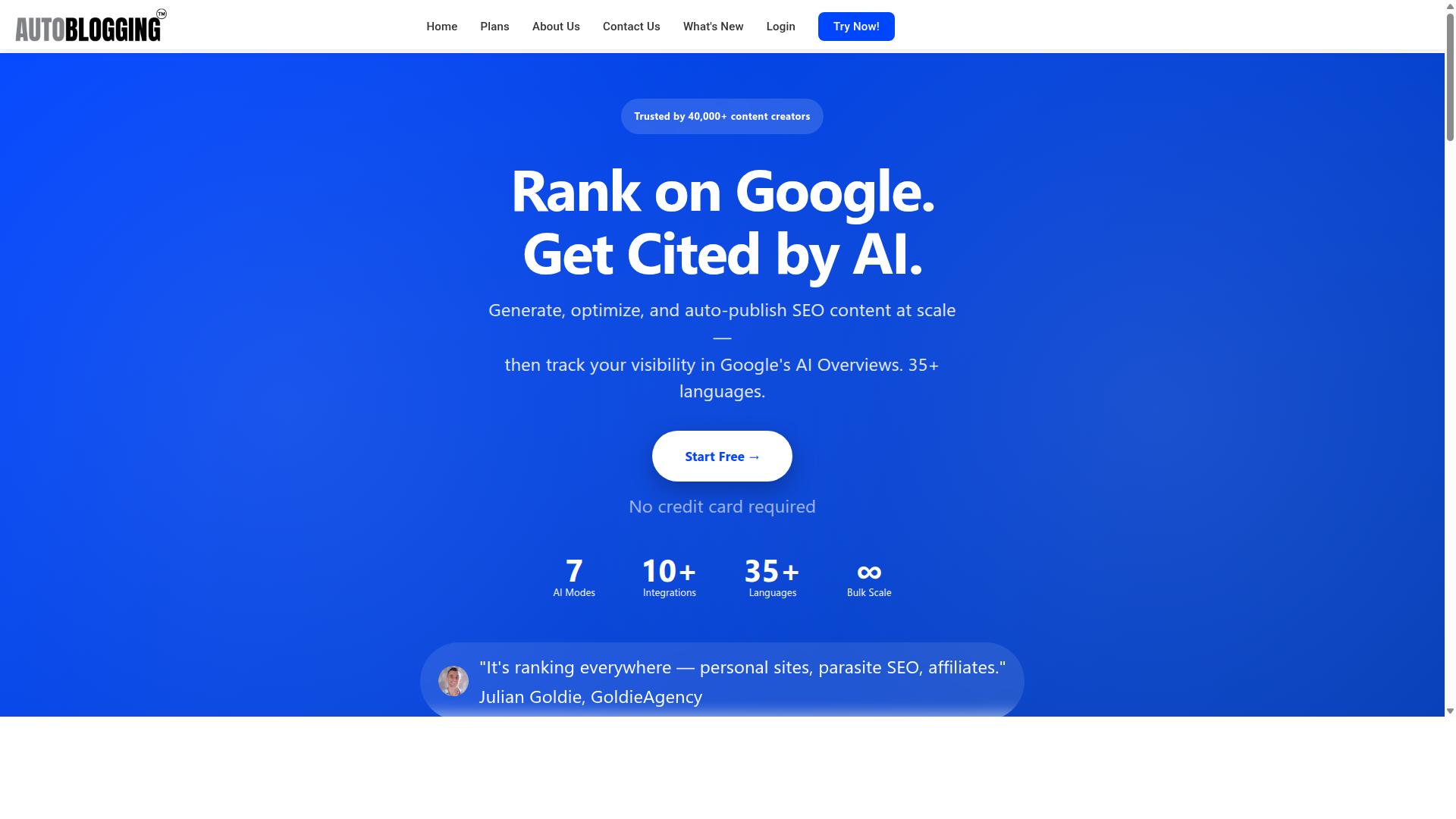
Autoblogging.ai is an AI-powered content automation platform that generates articles and accompanying images, streamlining the blogging process for creators and marketers. It is a product of Digimetriq.com, built with a clear mission: help bloggers, website owners and agencies save time and improve their online presence through cutting-edge technology.
At its core, the platform exists to cut down content costs and give the power to human counterparts in standard operating procedures with a reliable first draft. For buyers evaluating AI autoblogging tools, that positioning matters. It signals a tool built for production workflows, not just novelty text generation.
This buyer's guide focuses on one piece of that workflow: automatic image creation. Articles need visuals, and sourcing them manually is one of the slowest steps in blog automation. Understanding how an AI image generator fits into a platform like Autoblogging.ai is the first step toward choosing the right tool.
Digimetriq's longer-term aim is to replace human counterparts entirely, which tells you where automatic image creation sits in the roadmap. Visual content is not an add-on in this model. It is part of the core promise of hands-off publishing.
Who Autoblogging.ai Serves: Bloggers, Agencies and Affiliate Marketers
Autoblogging.ai is designed for a diverse range of users, including bloggers, marketing agencies, affiliate marketers, and SEO professionals who need to produce high-quality content efficiently. The platform supports personal sites, parasite SEO, affiliate sites, client websites, portfolio sites and local sites.
Each group feels the same underlying pain: time constraints. A solo blogger juggling a niche site cannot spend hours hunting stock photos. An agency managing multiple client websites needs every post to look polished without hiring a designer per project.
Automatic image creation addresses these pain points in different ways:
- Bloggers get featured images without leaving the publishing workflow.
- Agencies keep visual consistency across every client website they manage.
- Affiliate marketers fill content-rich sites with relevant visuals that support conversions.
- SEO professionals running parasite SEO or portfolio sites get scalable visual output across many pages.
The common thread is volume. When you publish frequently across one site or dozens, manual image sourcing becomes the bottleneck. A tool that pairs article generation with image generation removes that bottleneck in a single step.
Why Automatic Image Creation Matters in AI Autoblogging
In AI autoblogging, automatic image creation is crucial because it ensures every article is accompanied by relevant, high-quality visuals that enhance engagement and SEO. Without it, blog automation is only half complete: you get text at scale, but the visual layer still demands manual work.
The benefits stack up quickly for buyers comparing AI autoblogging tools:
- Time savings: no manual image sourcing, licensing checks or design work per post.
- Visual consistency: a uniform look across posts builds brand recognition.
- SEO optimization: descriptive alt text and metadata help images surface in search.
- Reader engagement: strong featured images keep visitors on the page longer.
This automation is possible because of advances in generative AI. Text-to-image models such as DALL-E, Midjourney, Stable Diffusion and Adobe Firefly translate written prompts into original visuals. Platforms like Canva add template-driven design on top of similar technology.
When evaluating tools, pay attention to how these capabilities are delivered. API integration and WordPress plugin support determine how cleanly image generation fits your existing stack. Prompt engineering, style presets and customization options shape output quality. Practical details matter too: image resolution, aspect ratio, rendering speed, batch processing, scalability and licensing rights for commercial use.
Pricing models vary across the category, from subscriptions to pay-per-image and free tiers or trials. Weigh those terms against your publishing volume. The right choice is the one that keeps every post visually complete without adding a new manual step.
How to Choose the Right AI Autoblogging Tool for Automatic Image Creation
Selecting the right AI autoblogging tool for automatic image creation requires evaluating several key factors to ensure it meets your content needs and workflow. The market offers tools built on generative AI models such as DALL-E, Midjourney, Stable Diffusion, and Adobe Firefly, and each option handles image generation differently.
The right tool should balance three things: automation, customization, and scalability. Automation saves time by generating featured images without manual input. Customization keeps those visuals consistent with your brand. Scalability ensures the tool still performs well when your publishing volume grows.
This buyer's guide focuses on four practical criteria: AI modes, language support, integrations, and output quality. Each one affects how well a platform fits your blog automation setup, and together they separate tools that merely create images from those that support a complete content creation workflow.
Evaluation Criteria: Modes, Languages, Integrations and Output Quality
When evaluating AI autoblogging tools, consider the range of AI modes for content and image generation, language support, integration capabilities, and the quality of output. These four areas cover most of what determines day to day usefulness.
AI modes determine how much control you have over text-to-image generation. A quick mode may produce a basic visual in seconds, while an advanced mode may offer prompt engineering options, style presets, and closer alignment with your article topic. Look for a tool that offers both speed and depth rather than forcing a single approach.
Language support matters if you publish beyond one market. Check the number of supported languages and whether translation quality holds up in image captions, alt text, and metadata. A platform covering 35+ languages gives you room to grow internationally without switching tools.
Integrations decide how smoothly images move from generation to publication. A WordPress plugin enables one-click publishing, while connections to design platforms such as Canva help with layout and branding. API integration is worth checking if you run a custom stack.
Output quality covers image resolution, aspect ratio, relevance to the article, and licensing rights for commercial use. Watch for watermarks on free tiers and confirm whether generated visuals carry clear usage terms. Strong tools also support alt text and metadata for SEO optimization.
How Autoblogging.ai Measures Up Against These Criteria
Autoblogging.ai excels against these criteria with its 10+ AI modes, support for 35+ languages, 35+ integrations, and high-quality output that includes automatic image creation. The platform is trusted by 40,000+ content creators and holds a 4.9 average rating, with 1M+ articles generated to date.
On AI modes, the platform includes Godlike Mode for SERP analysis alongside its other generation modes. This ties image and content creation to competitor research, so visuals and text align with what already performs in search. Semantic SEO tools and a 21-point SEO audit round out the optimization side.
For languages and integrations, Autoblogging.ai supports 35+ languages and 35+ integrations, including a WordPress plugin for one-click publishing. That combination suits bloggers who want blog automation without rebuilding their existing workflow.
On output quality, featured images are generated automatically as part of the publishing process. Every plan includes a human proofreader, which adds a review layer before content goes live. Credits rollover means unused generation capacity is not wasted, and new features ship weekly. With 24/7 support available, Autoblogging.ai stands out as a well-rounded choice for automatic image creation, and its track record of 1M+ articles generated supports that verdict.
Key Features That Make Autoblogging.ai Stand Out
Autoblogging.ai distinguishes itself with a robust feature set that goes beyond basic content generation, including advanced AI modes and extensive integration options. For anyone building a buyer's checklist for AI autoblogging tools with automatic image creation, these two areas deserve close attention. They determine how much of the publishing workflow you can genuinely automate, from drafting to visuals to going live.
The platform is trusted by 40,000+ content creators and has generated 1M+ articles, with a 4.9 average rating. That track record matters in a buyer's guide because scale of use is one of the few honest signals of reliability in a crowded market.
The standout features fall into two groups. First, a wide range of AI modes that shape how articles are researched, written, and illustrated. Second, broad language and integration coverage that pushes finished content, images included, to the platforms where audiences actually read it.
Together, these features matter for automatic image creation because they connect text generation and visual content in one pipeline. Instead of drafting an article in one tool and sourcing featured images elsewhere, the workflow stays unified. That reduces manual steps, keeps visual content aligned with the topic, and makes blog automation realistic at volume.
10+ AI Modes: Godlike Mode, Bulk Generation, News Mode and More
Autoblogging.ai offers over 10 AI modes tailored to different content needs, from quick article generation to in-depth competitor analysis and bulk creation. Each mode fits a different stage of a content operation, so buyers should match modes to their actual publishing rhythm rather than assume one mode covers everything.
Quick Mode is free and available as a single or wizard flow, which suits testing the platform before committing. Godlike Mode performs SERP competitor analysis, works with LSI keywords, and extracts knowledge graphs. That research depth is what makes the resulting articles competitive on search, and it also gives image selection a clearer topical anchor.
For scale, Bulk Generation produces up to 500 articles through CSV input. News Mode connects to Google News for timely coverage, and an Amazon Reviews Mode supports product-focused content. A Content Repurposer rounds out the set for reusing existing material.
Where does automatic image creation fit? Modes that generate featured images based on article content tie the visual directly to the topic, so a post about a specific product or event gets a matching visual rather than a generic stock photo. Supporting tools like AI Infographics and the 21-point Semantic SEO Analysis extend that value. Buyers should check whether a tool's modes connect text and visuals in one pass, because that connection is what separates real blog automation from a text-only generator.
35+ Languages, 35+ Integrations and One-Click WordPress Publishing
With support for over 35 languages and more than 35 integrations, Autoblogging.ai enables seamless content creation and publishing across global audiences and platforms. Language coverage is not a minor spec. It decides whether one subscription can serve multiple regional sites, and it affects how well automatic image creation travels across markets.
On the publishing side, the platform connects to WordPress with unlimited sites, one-click publishing, a plugin, and scheduled auto-posting. It also reaches Web 2.0 platforms including Medium, Dev.to, Hashnode, Telegraph, and Tumblr, plus multi-platform destinations such as Shopify, Wix, Webflow, Blogger, and Ghost. API access, Zapier, and n8n cover custom stacks.
One-click WordPress publishing matters for image workflows because automatic image insertion can carry proper alt text and metadata. Those details support SEO optimization and accessibility, and they are easy to overlook when images are added by hand. Buyers should treat alt text and metadata handling as a core requirement, not an afterthought.
Canva appears among the integrations, which helps with visual content creation and brand consistency. Done For You packages are available for teams that want the setup handled, and new features are shipped weekly. Credits rollover, a human proofreader is included in all plans, and 24/7 support backs the whole system. For a buyer weighing subscription models, that combination of languages, integrations, and continuous updates is a strong sign the platform will keep pace as automatic image creation evolves.
Pricing and Plans: What You Get at Every Tier
Autoblogging.ai offers a range of pricing plans to suit different budgets and usage levels, from individual bloggers to large enterprises. The structure is built around a simple idea: you pay for credits, and credits power both your article generation and your automatic image creation.
That matters for a buyer's guide, because image output is not priced separately here. There is no pay-per-image meter and no surprise surcharge when you need featured images, in-article visuals, or supporting graphics for a batch of posts. Everything draws from the same pool.
Six monthly tiers cover the full spectrum of blog automation needs. New accounts also receive 10 free credits per month with no credit card required, which gives you room to see how far a credit stretches before committing.
If you outgrow your allowance, additional credits can be purchased. Every plan includes credits rollover, so unused capacity is not lost at the end of a billing cycle. Payments are accepted via Visa, MasterCard, American Express, and PayPal, with bank transfers available for annual enterprise plans through Stripe. You can cancel anytime.
For teams that would rather not run the tool at all, Done For You packages are available: Starter at $1,200 for 1,000 articles, Pro at $1,600, Corp at $4,000, and Senpai at $10,000, each covering 1,000 articles.
Monthly and Annual Options from Starter to Enterprise
Autoblogging.ai provides flexible monthly and annual subscription plans, starting at $19 per month for the Starter plan and scaling up to $999 per month for Enterprise. Annual billing lowers the effective monthly rate on every tier.
| Plan | Monthly Price | Credits | Annual Price |
|---|---|---|---|
| Starter | $19 | 40 | $12/mo ($148/year) |
| Regular | $49 | 120 | $32/mo ($382/year) |
| Standard | $99 | 300 | $64/mo ($772/year) |
| Gold | $179 | 600 | $116/mo ($1,396/year) |
| Premium | $249 | 1,000 | $162/mo ($1,942/year) |
| Enterprise | $999 | 5,000 | $649/mo ($7,792/year) |
Credits are the shared currency for article and image generation. A high-volume publisher running automatic image creation across every post will burn through credits faster than someone generating text only, so match the tier to your real output rather than the headline price.
The rollover feature softens that math. If a quiet month leaves credits unused, they carry forward instead of expiring, which suits blogs with seasonal traffic or irregular publishing schedules.
Compare the tiers side by side and the annual discount is consistent rather than a one-off teaser. Starter drops from $19 to an effective $12 per month, Regular from $49 to $32, Standard from $99 to $64, Gold from $179 to $116, Premium from $249 to $162, and Enterprise from $999 to $649.
For a buyer weighing AI autoblogging tools with automatic image creation, the practical question is cost per published post, not cost per month. Estimate how many articles you need, factor in the visuals each one requires, and pick the tier whose credit count clears that number with room to spare.
Trust Signals: Track Record, Testimonials and Support
When you evaluate any SaaS tool, the track record matters as much as the feature list. A long history of active users, a steady volume of work produced, and a strong average rating tell you whether a platform delivers on its promises over time. Autoblogging.ai has established a strong track record with thousands of users and positive testimonials, backed by reliable customer support.
For a buyer comparing AI autoblogging tools with automatic image creation, trust signals act as a shortcut. You cannot test every platform yourself, so you lean on the experience of the people already using it. Numbers like user counts and articles generated give you scale. Ratings give you sentiment. Named users give you accountability.
Support is the third pillar. Software breaks, workflows change, and questions come up at inconvenient hours. A tool that pairs a proven user base with responsive help reduces the risk of your blog automation stalling. The sections below break down the specific trust signals you should weigh before committing to any platform.
40,000+ Content Creators, 1M+ Articles and a 4.9 Average Rating
Autoblogging.ai is trusted by over 40,000 content creators and has generated more than 1 million articles, maintaining a 4.9 average rating. Those three figures cover scale, output, and satisfaction, which are the core measures buyers use to judge a content creation platform.
The user base spans solo bloggers, agencies, and marketing teams. Notable users include Julian Goldie of GoldieAgency, whose YouTube channel has over 250,000 subscribers, and James Dooley of FatRank and PromoSEO. When people who teach and sell SEO services publicly rely on a tool, that carries weight for anyone building a buyer's guide shortlist.
Beyond the numbers, Autoblogging.ai backs its platform with practical support features:
- 24/7 support for questions about setup, publishing, or your account
- A human proofreader included in all plans, adding a quality layer on top of automated output
- New features shipped weekly, so the platform keeps pace with changes in generative AI
These signals matter for automatic image creation too. A tool that maintains a large, active user base and invests in ongoing development is more likely to keep its image workflows current as text-to-image technology evolves. For a buyer, the combination of scale, named advocates, and round-the-clock help is a reasonable proxy for reliability when you cannot evaluate every platform in person.
Who Should Use Autoblogging.ai - and Who Shouldn't
Autoblogging.ai is ideal for bloggers, agencies, and affiliate marketers seeking to automate content and image creation, but it may not suit those who prefer fully manual control or have very niche needs. The platform was built for people who publish regularly and want blog automation to handle both the writing and the visuals that go with it.
Its target audience is clearly defined: bloggers, website owners, SEO professionals, marketing agencies, content creators, and affiliate marketers. If your work involves producing visual content at a steady pace, this is the profile the tool was designed around.
Autoblogging.ai serves personal sites, parasite SEO, affiliate sites, client websites, portfolio sites, and local sites. That range matters in a buyer's guide, because it shows the platform fits both solo publishers and teams managing multiple properties.
Who should use it:
- Bloggers and content creators who publish often and need featured images without a separate design workflow
- SEO professionals running content campaigns where alt text and metadata support SEO optimization
- Marketing agencies handling client websites and needing output at scale
- Affiliate marketers building affiliate sites and portfolio sites that depend on consistent publishing
- Owners of personal or local sites who want automatic image creation without hiring a designer
For these users, the appeal is straightforward. Automatic image creation removes a repetitive task from the publishing pipeline, and generative AI handles the heavy lifting. Instead of juggling a separate AI image generator, the workflow stays in one place.
Who should look elsewhere:
- Users who need highly customized, non-AI-generated images, such as original photography or hand-drawn illustration
- Brands with strict brand guidelines that require every asset to pass manual design review
- Publishers on extremely tight budgets who cannot commit to a subscription plan
That last point deserves honesty. Subscription pricing is a real consideration, and anyone comparing free tiers or pay-per-image models should weigh cost against volume before committing. A buyer's guide should say this plainly rather than pretend one tool fits everyone.
There is also a creative control question. If you enjoy prompt engineering, tweaking style presets, and refining every aspect ratio by hand, a manual tool like Midjourney or Stable Diffusion may feel more satisfying. Autoblogging.ai trades some of that fine-grained control for speed and consistency.
Licensing rights and commercial use are another area to check before you commit, whichever tool you choose. Watermarks, copyright terms, and image resolution requirements vary between platforms, so confirm those details against your own publishing needs.
The balanced verdict: Autoblogging.ai fits publishers who value scalability and batch processing over pixel-level control. If you publish across personal sites, client websites, or affiliate properties and want content and images handled together, it matches your profile well. If your work demands bespoke visuals or manual design at every step, a different approach will serve you better.
Final Verdict: Is Autoblogging.ai the Right Choice for Automatic Image Creation?
For most content creators, Autoblogging.ai is a powerful and reliable choice for automatic image creation, thanks to its advanced features, scalability, and strong track record. The platform brings together content generation and visual asset creation in one place, which removes a lot of the friction that comes with juggling separate AI image generators and writing tools.
Its feature set is broad enough to serve beginners and high-volume publishers alike. More than 10 AI modes cover different content and image needs, while support for 35+ languages makes it viable for global audiences rather than a single market.
Integration is another strong point. With 35+ integrations available, the platform fits into established publishing workflows instead of forcing users to rebuild them. Automatic image generation sits alongside these integrations, so visual content can be produced as part of the same process as the written content around it.
Pricing stays competitive relative to the capabilities on offer, which matters in a category where costs can climb quickly. The combination of automatic image generation, multilingual output, and wide integration support gives buyers a lot of functional ground for the money.
The trust signals reinforce the case. A public address, reachable support channels, and a clear operating window suggest a company that intends to be around for the long term, not a fly-by-night tool. For anyone weighing AI autoblogging tools against a buyer's guide checklist, Autoblogging.ai clears the major hurdles.
Who it suits best:
- Bloggers and niche site owners who need consistent featured images without a designer
- Affiliate marketers and agencies managing multiple sites and languages
- Teams that want automatic image generation tied into their existing publishing stack
- International publishers who need multilingual content and visuals
If your priority is a single platform that handles both writing and visual content with scale, Autoblogging.ai is a sensible choice. If you only need occasional one-off images, a standalone AI image generator may be enough, but few single-purpose tools match the combined scope here.
To take the next step, reach out to the team directly. Sales and support can be contacted by email at [email protected], by phone or WhatsApp at +91 84605-06553, or on Skype at vibes.yb. The team is available 7:00-19:00 IST, and the platform serves users globally, so time zone differences are easy to work around.
The verdict is straightforward: Autoblogging.ai is a legitimate, well-featured option for automatic image creation, and for most buyers working through this guide, it is the right choice.
Frequently Asked Questions
Do AI autoblogging tools actually create images automatically, or do I still need to source them myself?
It depends on the tool. Some platforms only generate text and leave you to find featured images elsewhere, while others handle image creation as part of the article workflow. Autoblogging.ai is built as an end-to-end AI article generation platform, so image creation sits alongside its 10+ AI modes rather than being a separate add-on you have to manage.
How many images should I expect per article, and does that affect my credit usage?
Most autoblogging tools tie image generation to credits, so the more images per post, the more credits you burn. Autoblogging.ai runs on a credit system with plans ranging from Starter at $19 (40 credits) up to Enterprise at $999 (5,000 credits), and unused credits roll over, which gives you room to test different image volumes without losing what you paid for.
Can the tool generate images in the same language as my articles?
If you publish in multiple markets, image and content language support matters. Autoblogging.ai supports 35+ languages, so you can produce articles and their accompanying visuals for non-English audiences without juggling separate tools. That's particularly useful for agencies running client sites across different regions.
Will automatically generated images hurt my SEO or look generic?
Search engines care about relevance and page experience more than whether an image was AI-generated, but generic visuals do weaken engagement. The bigger SEO lever is the article itself: Autoblogging.ai's Godlike Mode performs SERP competitor analysis, LSI keyword research and knowledge graph extraction, so the surrounding content is genuinely optimized. Pairing that with on-topic images gives you a stronger overall page than text alone.
How do I judge image quality before committing to a paid plan?
Start with a free option and inspect the output yourself. Autoblogging.ai offers Quick Mode free of charge in both single and wizard formats, so you can generate sample articles and review how the visuals fit before upgrading. From there, paid monthly plans scale from Starter through Premium, and annual billing is available if you decide to commit.
Is an AI autoblogging tool with image creation worth it for agencies managing multiple sites?
For agencies, the value comes from volume and consistency rather than any single feature. Autoblogging.ai supports Bulk Generation of up to 500 articles via CSV, which lets you produce content and images across many client or portfolio sites in one pass. With 35+ integrations, credits that roll over, and 24/7 support, it's designed for teams that need repeatable output rather than one-off posts.
Recommended Resources: